Wednesday, April 20, 2016

After School Math course for grade 7&8 Students

This spring, All Saints will be offering an after school Numeracy Course for students in grades 7&8.  This is an optional course that will provide additional instruction, practice and review of important Math concepts.  The course will consist of 12 sessions, with the classes beginning on Wednesday April 27th until June 8th.  These sessions will take place in room N110 on Monday and N112 on Wednesday, starting at 2:40 p.m. and ending at 3:40 p.m.  Mrs. Morrison  will be teaching this course on Mondays and Mrs. DeLuca on Wednesdays. The focus of these sessions will be on reinforcing classroom instruction and reviewing concepts covered earlier in the year that will be important for success in high school.   Please be aware, that this course must have a sufficient number of students enrolled in order for it to be feasible.  If you choose to sign up your child, you will be informed if the enrollment in not sufficient to run this course.   
While there is no charge for the course, transportation home following the session each evening is the responsibility of the parent/guardian.
If you are interested in signing your son/daughter up for the course, or have any specific questions, please contact Mrs. M. J. Gillier-Symes, grade 7&8 Vice Principal, at the school.

Monday, April 18, 2016

My Blueprint parent account information


Having trouble seeing this email? View this email in your browser

Parent Engagement and the
New Parent Account

The new Parent/Guardian Account is here! It is now even easier for parents to get involved in the education and career/life planning process. Parents can create an account to:
  • Link to their child's Student Account and view their child's progress in a simple summary view
  • Use Student View to explore courses, post-secondary programs, and occupations without affecting their child's progress
  • Collaborate with their child to make the most informed decision about their future
Click to read more on 6 Great Ways to Engage Parents in your school community and to check out the new myBlueprint Parent/Guardian Account.

Did you know? Students are more likely to be motivated, to earn higher grades, to have better behavior and social skills, and to continue their education to a higher level when their parents are actively engaged in supporting their success at school.
Twitter
Facebook
Website
Email
Copyright © 2016 myBlueprint, All rights reserved.
You are receiving this email because you have created an account at myBlueprint.ca. We send information to keep you up to date with what is happening at myBlueprint

Our mailing address is:
myBlueprint
3376A Yonge st
Toronto, On M4N2M7
Canada

Add us to your address book


Want to change how you receive these emails?
You can update your preferences or unsubscribe from this list
 

Tuesday, April 12, 2016

Four days.... Two major movements....

But, folks, we're not done yet – indeed, nowhere close.

If anything, Friday's release of Amoris Letitia and this morning's appointment of the new Stateside Nuncio are merely the beginning of storylines whose fallout will continue to loom large on the scene over the next several weeks.

Between those two, another round of the usual curveballs – and a "Final Four" soon in the offing – the spring cycle ahead should make for a very full plate. As it's always been 'round here, though, keeping at the news is only possible thanks to this readership's part at keeping the shop's bills paid.

Much as this scribe likes keeping the only ad you'll ever see here at a minimum, with the usual monthly expenses currently running into the annual tax onslaught, the Whispers budget faces another mountain to get past for these pages to continue doing what they do best.

Long story short: as it's the one thing the news-side can't pull off, Church, this one's all yours....


...and now, back to it. At least, here's hoping.

Even more than usual, this should be fun... and as it awaits, God reward you real good – all thanks as always.

-30-

The Pope's Border Song – Francis Names Pierre as Nuncio to US

Expected for weeks, it's now real: at Roman Noon, the Pope named 70 year-old Archbishop Christophe Pierre as his Nuncio to the United States, retiring Archbishop Carlo Maria Viganò three months after the post's holder since 2011 turned 75.

While the incoming occupant of 3339 Massachusetts Av NW may exercise the ecclesial prerogatives of his new posting immediately, the secular piece of Pierre's role – as the Holy See's ambassador to the Federal government – can only get underway once he presents his credentials to President Obama.

Given the Frenchman's assignment until today as Nuncio to Mexico, his arrival is expected to take place within a quicker timeframe than the usual 6-8 weeks since, unlike any prior choice for the DC posting, Pierre doesn't need to move across an ocean to make it there.

For all the rest, the following piece anticipating the move was originally published here last month as reports of the choice began to emerge.

More to come... in the meantime, discerning readers might want to revisit Francis' now-famous February speech to the Mexican bishops, in whose drafting Pierre's voice is said to have held a significant weight.

* * *
10 March 2016 – Less than two months since Archbishop Carlo Maria Viganò reached the retirement age of 75 – and, indeed, all of two days after the topic came up here – the choice of his successor as Apostolic Nuncio to the US is reportedly at hand: in a piece published earlier today on his Settimo Cielo blog, the conservative Italian vaticanista Sandro Magister indicated that Archbishop Christophe Pierre (above), the 70 year-old French-born legate to Mexico, is the Pope's selection for the Washington posting, with an announcement said to be "imminent."

A mission-chief for 20 years – and the Vatican's man in the global church's second-largest outpost since 2007 – the reported choice would mark another move by Francis to highlight the "peripheries" toward which the pontiff has ceaselessly prodded the church; Pierre's first assignment as a Nuncio was a four-year stint (1995-99) in Haiti, the poorest country in the Western hemisphere. In addition, two weeks after the Pope's long-desired stop at Mexico's US border – and subsequent doubling-down on the advocacy that spurred it – what would be a provocative transfer north given the US' current political climate would bring a figure intimately familiar with matters of immigration as the Holy See's representative to the US government, to say nothing of the Nuncio's role as the Pope's eyes, ears and voice to an American Catholic fold which has been transformed (and, in some quarters, roiled) by a historic influx from Latin America. On yet another key front, unlike the prior lead occupants of 3339 Massachusetts Av NW, Pierre would arrive in the States with an unusually well-steeped understanding of the church in the Southern and Western US, which have jointly surpassed the old bastions of the Northeast and upper Midwest over recent years to become the home of a majority of the nation's 70 million faithful.

All at once, the prospect of Pierre's appointment would both come as a surprise and not as one. While the name of the Frenchman has circulated in authoritative circles only over the last six weeks or so, from the outset of the succession planning, the most widely cited name for the DC post has been Archbishop Celestino Migliore, the bubbly Italian who won great acclaim and affection in New York's church and diplomatic circles over his eight years as the Holy See's permanent observer to the United Nations headquarters there.

Now 63 and transferred to Poland in 2010, the onetime "deputy foreign minister" in the Secretariat of State notably became the first quarterback for the Vatican's amplified environmental push under Benedict XVI, which Migliore championed on the Holy See's behalf in the UN's deliberations. That said, a current of opposition to Migliore's appointment to the US began circulating early this year, and given the word of Pierre's selection, the Mexico rep.'s experience with migration issues – and the Pope's ostensible desire to send another message on their import – would appear to have tipped the balance in his favor, as well as a likely reluctance to transfer the Nuncio to Warsaw with months to go before Francis' late July trek to Poland for World Youth Day in Krakow.

An informal cleric described as friendly and "savvy," one ranking op who knows Pierre praised the choice, telling Whispers that the archbishop "knows how to hold onto the rudder in the midst of storms." Given the tensions of the moment on church and civil fronts alike on this side of the border, that skill would be in for quite the test.

*   *   *
As Francis marks the third anniversary of his election on Sunday, it bears recalling that Papa Bergoglio has bucked the tradition of his predecessors in opting to stick with the US representative he inherited for a lengthy period of time. Over the last half-century and more, each new Pope has traditionally placed a diplomat of his own choosing in Washington within the first year or two of his pontificate, reflecting the assignment's immense clout both on geopolitical and ecclesial fronts, above all in the Nuncio's most consuming and consequential function: compiling the extensive amounts of consultation, research and reports which set the stage for the appointment of every American bishop.

Named to the US in October 2011, Viganò's assignment to the post was widely perceived as an "exile" from Rome in the wake of his unsuccessful campaign to root out mismanagement and graft in Vatican City's finances and contracts as the city-state's deputy mayor. Within weeks of his arrival in Washington, the archbishop's earlier pleas to Benedict for his support in the reform effort became a centerpiece of the incendiary "Vatileaks" document haul, which destabilized the Curia for the bulk of 2012 while winning Viganò a reputation for courage in the face of apparently irredeemable corruption.

In the wake of Francis' election, the new Pope's push for Curial accountability and a financial cleanup led to well-placed expectations that Viganò would see his triumphant return to Rome in a top post. The speculation turned to naught, however, after a smear campaign by the archbishop's enemies which circulated in the Italian press is believed to have short-circuited the move.

Having laid the groundwork for the Pope's markedly successful East Coast trip last September, the career diplomat landed in the center of another firestorm in the visit's wake when it emerged that Kim Davis – the Kentucky county clerk whose brief imprisonment for refusing to perform same-sex marriages on religious freedom grounds became a cause celebre in the culture wars – was quietly greeted by Francis at the DC Nunciature between public engagements. In a remarkable clarification issued in response to the furore caused by word of the meeting, a Vatican statement said that, with Davis among "several dozen" people present, "such brief greetings occur on all papal visits and are due to the Pope’s characteristic kindness and availability."

Emphasizing that "the Pope did not enter into the details of the situation of Mrs Davis and his meeting with her should not be considered a form of support of her position in all of its particular and complex aspects," the statement sought to further distance Francis from the clerk in adding that "the only real audience granted by the Pope at the Nunciature was with one of his former students and his family." Long based in Washington, the former student was later found to be openly gay and had brought his partner to the encounter.

Having won wide esteem among the US bishops with his gracious style, quiet assists and commitment to a heavy travel schedule to take part in local church events, Viganò was feted by the bench at last November's plenary in Baltimore with the traditional champagne sendoff which the USCCB accords to a Vatican representative attending his final meeting. That said, as the archbishop's success at ultimately obtaining the appointments of those he's recommended has largely been stymied by the influence of the Stateside cardinals on the Congregation for Bishops – whose votes determine the ultimate endorsement of a candidate to the Pope – Viganò's "swan song" pick on these shores is understood to have been the July elevation of one of his favorites, Fr Robert Barron, as auxiliary bishop of Los Angeles. At the time, the move stoked widespread amazement among the American hierarchy given the highly unusual transfer of the Chicago-based media titan to the global capital of pop culture.

As previously reported, with almost a dozen of the nation's 197 dioceses currently awaiting new leadership, the bulk of the docket has been in a holding pattern over the last several months in anticipation of a new Nuncio. Once the transition has taken place, further delays are expected as the newcomer reviews the pending files and familiarizes himself with the lay of the land.

-30-

Sunday, April 10, 2016

All Saints Blog Week of April 11th, 2016

School Council Meeting / PD Day
A reminder that we will be hosting a school council meeting this Monday, April 11th at 7:00 in our school learning commons.  You can find a link to the proposed agenda here.  A reminder that this Friday, April 15th is a pd day.  There is no school for students.  Staff is working on our school innovation plan with training around health and safety.

Grade 7 Curling Team Tournament
Congratulations to a group of our grade 7 boys who were participating in the Timbits Elementary Curling Championships this past weekend in Gananoque.  The boys played really well but lost in the bronze medal game. Quite an amazing accomplishment - finishing 4th out a total of 56 teams at provincials. They were one of the youngest teams in terms of experience and they really represented All Saints well in terms of play, sportsmanship and behaviour.  Thanks to Mr. Trahan who coached and supervised the group.

All Saints - Doors of Mercy
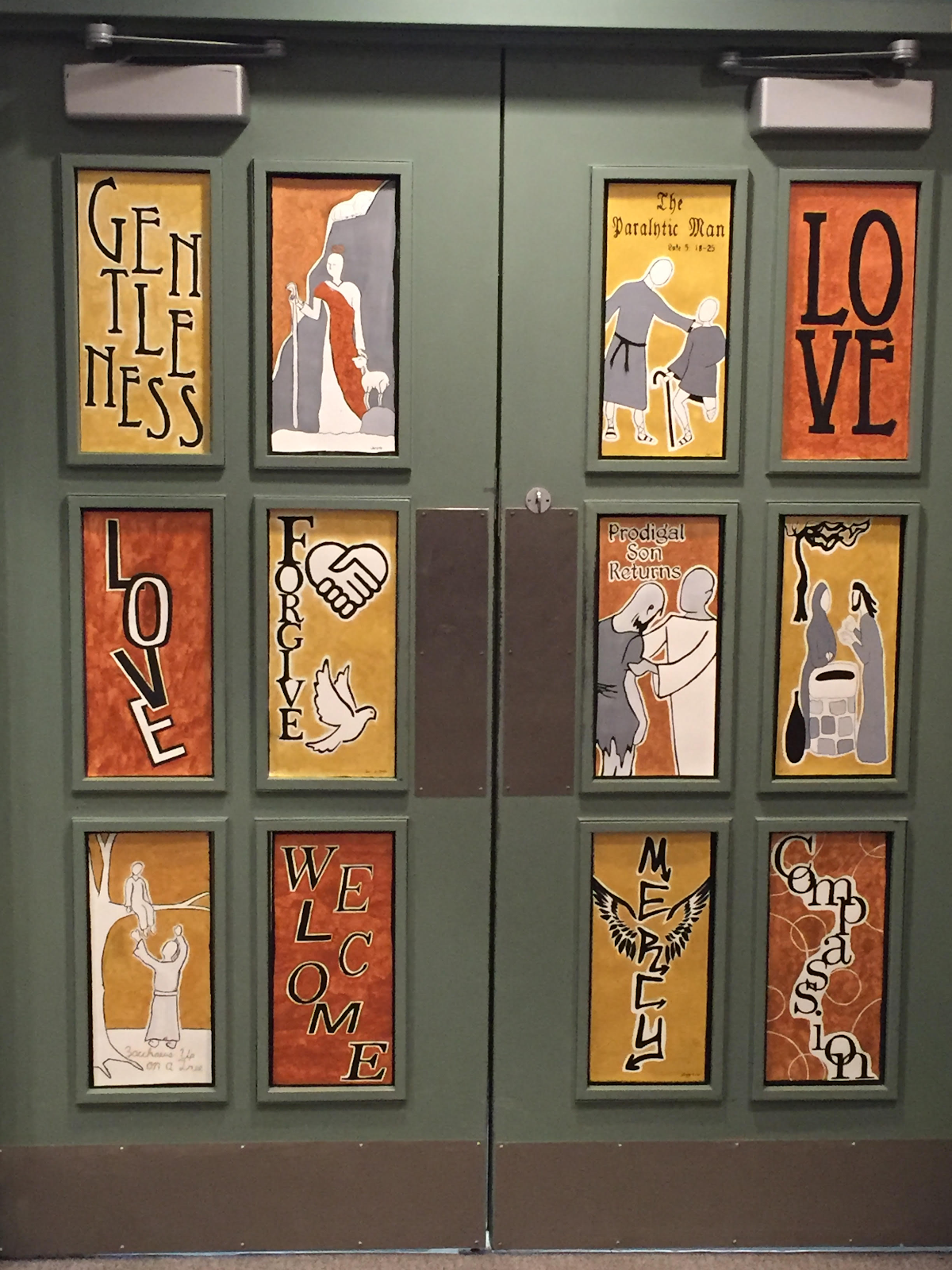
On March 13, 2015, Pope Francis declared an Extraordinary Jubilee Year of Mercy.  The year began on the Feast of the Immaculate Conception on December 8th.  Symbolic to a Jubilee Year, we celebrate Holy Doors and a symbolic act of pilgrimage is to walk through the Holy Doors.  Catholic school boards across Ontario will celebrate and live out this year of mercy in many ways. Each diocese will have events to mark this historic moment in our church. Our own Catholic Education Week (May 2nd to 6th) is called ‘Opening Doors of Mercy’.  To observe this very special religious observation, the doors to All Saint’s chapel have been transformed into our own “Holy Doors of Mercy”.  We will be highlighting our doors when our grade 6 students visit for transition activities later this spring.  A huge thank you to Mr. Mastersmith’s grade 11 class for their artistic renditions.

Community Recognition Award Ceremony
Councillor Wilkinson’s Community Recognition Award Ceremony is fast approaching, taking place on Sunday May 1st, 2016 from 7:00-9:00pm at the Mlacak Centre. The purpose of the ceremony is to recognize key individuals who have positively impacted the Kanata North Community through their volunteer efforts and contributions.
Four awards are given out at the ceremony under the following categories:
  • Citizen of the Year
  • Senior Citizen of the Year (65 years or older)
  • Youth Citizen of the year (18 years or younger)
  • Organization of the Year
If you know of anyone who has done a lot of volunteer work in the last year and should be recognized for their efforts please complete the nomination form at the website below. Additionally, feel free to pass along this e-mail to anyone who may be able to nominate a teacher, student or anyone else who volunteers within your school and makes All Saints Catholic High School a better place.
Additional details about the event and the process to nominate an individual can be found at www.mariannewilkinson.com or by calling 613-580-2474. The deadline for nominations is April 22, 2016.

All Saints Vocal Class at Kiwanis Festival (submitted by Grace Davidson)
If you take a little stroll down to room A102, you'll find much more than just a normal classroom. The high school music room is home to many classes including guitar class, vocal class, show choir, concert band, jazz band, and R&B band. Thanks to Ms. Van Zeeland and Ms. Little, these music classes/group have been very successful in all that they do!
This past Monday, April 4th, the All Saints vocal class took part in the Kiwanis Festival where they showcased their recent choral works, “Road to Freedom” and “Alleluia, Alleluia.” There, adjudicator Dr. Elroy Friesen gave the group many helpful tips including new ways to achieve a blended tone; something all good choirs strive for. He also offered up some man-to-man training for our lone baritone, which Ms. V is very grateful for.
Having another opinion as well as constructive criticism from someone who is well known in the choral community was extremely beneficial to students, and they are implementing the new techniques into their daily rehearsals. The vocal class left Kiwanis with a first place place award and a mark of 85! Ms. V is very proud of her students and the hard work and dedication they showed through the entire process.
Trips like this give music students opportunity to bond with each other in a way that’s different than most other classes. It's hardly possible to stay quiet on the bus as there is always the temptation to sing all the way there; I’m sure the bus driver didn't mind!
You really get to know each other when you're in a group like this vocal class. Music can be a very personal thing, and sharing with others can be scary sometimes. The positivity and support the kids show to each other is greatly influenced by their teacher, Ms. V, who has always taught them to be kind, positive, and confident. The atmosphere is one that most, if not all, students can't wait to come into every morning.

Sessions for Parents:
  • Understanding EQAO Assessments  
(Rescheduled following inclement weather March 1)
Every year, Ontario students in Grades 3, 6, 9 and 10 write province-wide tests.  These assessments provide an objective indication of how well students are developing the reading, writing and math skills defined in the Ontario Curriculum.
This presentation delivered by Mike Young, a principal from EQAO’s School Support and Outreach team, will give parents an opportunity to gain an understanding of the EQAO assessments.
Register Now:  http://bit.ly/CSPAEQAO
Tuesday, April 12, 2016
6:45 - 8:45 PM
Saint Joseph Catholic High School
3333 Greenbank Road, Barrhaven

  • Youth Substance Use – Supporting Youth and Families
Rideauwood Addiction and Family Services and the Ottawa Catholic School Board have worked in partnership for many years. Find out how the School Based Program provides support to students, and their families, throughout the phases of youth substance use, from prevention to intervention.
Learn signs and symptoms to be aware of and how to access help when needed.
Presenters:     Liz Parsons & Nadine McLean, Co-managers, Youth, Parent and School Based Program at Rideauwood Addiction and Family Services.
Thursday, April 21, 2016
7:00 PM – 8:45 PM
Sacred Heart Catholic High School
5870 Abbott St E, Stittsville

  • CSPA Math 4 Parents - Wednesday, April 20 at All Saints High School (7 - 8:45pm).  Learn more about how math is taught today in classrooms and how you can support your child's learning.  Two workshops will be offered on this evening at the same time.  Choose from Inquiry-based Mathematics in the Elementary Classroom (JK - Gr. 6) OR So Much Homework, So Little Time. Why is High School Math So Difficult? (Gr. 7 - 12)

Communications
Check out our blog – allsaintschs.blogspot.ca and our twitter @AllSaintsCHS as well as our website ash.ocsb.ca for all that is happening at All Saints!

Friday, April 8, 2016


POST-SYNODAL APOSTOLIC EXHORTATION

AMORIS LÆTITIA

OF THE HOLY FATHER

FRANCIS

TO BISHOPS, PRIESTS AND DEACONS
CONSECRATED PERSONS
CHRISTIAN MARRIED COUPLES
AND ALL THE LAY FAITHFUL

ON LOVE IN THE FAMILY


The Joy of Love experienced by families is also the joy of the Church. As the Synod Fathers noted, for all the many signs of crisis in the institution of marriage, “the desire to marry and form a family remains vibrant, especially among young people, and this is an inspiration to the Church”. As a response to that desire, “the Christian proclamation on the family is good news indeed”.

The Synod process allowed for an examination of the situation of families in today’s world, and thus for a broader vision and a renewed awareness of the importance of marriage and the family. The complexity of the issues that arose revealed the need for continued open discussion of a number of doctrinal, moral, spiritual, and pastoral questions. The thinking of pastors and theologians, if faithful to the Church, honest, realistic and creative, will help us to achieve greater clarity. The debates carried on in the media, in certain publications and even among the Church’s ministers, range from an immoderate desire for total change without sufficient re ection or grounding, to an attitude that would solve everything by applying general rules or deriving undue conclusions from particular theological considerations.

Since “time is greater than space”, I would make it clear that not all discussions of doctrinal, moral or pastoral issues need to be settled by interventions of the magisterium. Unity of teaching and practice is certainly necessary in the Church, but this does not preclude various ways of interpreting some aspects of that teaching or drawing certain consequences from it. This will always be the case as the Spirit guides us towards the entire truth (cf. Jn 16:13), until he leads us fully into the mystery of Christ and enables us to see all things as he does. Each country or region, moreover, can seek solutions better suited to its culture and sensitive to its traditions and local needs. For “cultures are in fact quite diverse and every general principle... needs to be inculturated, if it is to be respected and applied”.....


Francis' Feast – Pope's Hymn to Family "Is A Matter of Reaching Out to Everyone"

When you get to the part of Amoris Laetitia where the Pope says, “I certainly value feminism,” seeing the statement in a document of the Magisterium is enough to drop one’s jaw.

And, indeed, there’s more where it came from… most of which you’ll find in Chapter Eight. Yet while Francis himself warns against a “rushed reading” of the product, though the pontiff re-employs his maxim that “Time is greater than space,” another Francis-ism (albeit one unspoken here) offers the better summary:

“Life is bigger than explanations.”

Over 250 booklet pages – 60,000 words in length, including the yet-again critical footnotes – the most feverishly-awaited text of Francis’ pontificate closes the three-year Synodal process on the family by opening the wider church to a more sensitive and personalized style of pastoral outreach, even to the point where, as he defines today, it “can no longer simply be said that all those in any ‘irregular’ situation are living in a state of mortal sin and are deprived of sanctifying grace.”

In terms of the church’s response to hot-button issues of family life, while no teaching has formally been altered – and the pontiff repeatedly takes pains to underscore the “Christian ideal” of a couple’s lifelong, exclusive commitment while echoing the Synod’s firm rejection of same-sex marriage – the shift of tone from the top represents a sea-change, above all in extending the possibility of a “discernment” which recognizes that, in complex situations vis a vis church teaching, “the consequences or effects of a rule need not necessarily always be the same” (300), adding in a footnote that “this is also the case with regard to sacramental discipline,” citing the church’s “solid body of reflection concerning mitigating factors and situations.”

Given the intensity of focus on the most prominent and charged front for those questions: the admission of civilly remarried couples to the Eucharist – a practice rejected categorically by St John Paul II in 1981’s Familiaris Consortio – Francis’ reluctance to “provide a new set of general rules, canonical in nature and applicable to all cases” while going on to say “that in an objective situation of sin… a person can be living in God’s grace, can love and can also grow in the life of grace and charity, while receiving the Church’s help to this end” is capped by another footnote (351) which begins, “In certain cases, this can include the help of the sacraments,” making reference to his earlier comments that the Confessional is not to be used as “a torture chamber” and "that the Eucharist 'is not a prize for the perfect, but a powerful medicine and nourishment for the weak.'"

“[A] pastor cannot feel that it is enough simply to apply moral laws to those living in ‘irregular’ situations, as if they were stones to throw at people’s lives,” Francis writes. “This would bespeak the closed heart of one used to hiding behind the church’s teachings, ‘sitting on the chair of Moses and judging at times with superiority and superficiality difficult cases and wounded families’” – the Mosaic reference an echo to Jesus' Matthew 23 warning to the scribes and Pharisees about their hypocrisy.

“No one can be condemned for ever," the Pope says, "because that is not the logic of the Gospel!”

As for what it all means in practice, the old story bears recalling of the bishop who, on a visit to the CDF, was asked how prevalent internal forum conclusions for the remarried to receive Communion were in his area, only for the dumbfounded prelate to reply that the sacramentally-sealed nature of said discernment made it impossible to have any statistics on it.

“In every situation,” the Pope says, “when dealing with those who have difficulties in living God’s law to the full, the invitation to pursue the via caritatis must be clearly heard. Fraternal charity is the first law of Christians.” By contrast, meanwhile, the one occasion where the pontiff calls anyone’s disposition to Communion in question is focused on his usual target: “When those who receive [the Eucharist] turn a blind eye to the poor and suffering, or consent to various forms of division, contempt and inequality,” he says, the Blessed Sacrament “is received unworthily” (186).

All that said, even if Francis’ musing that “everyone should feel challenged by Chapter Eight” and its delving into discernment will likely get some significant takeup, the bulk of the mammoth text is disarmingly calm, dominated by lyrical reflections on family life, an extended meditation on 1 Corinthians 13 – St Paul’s treatise on love, the ever-ubiquitous reading at weddings – as well as a long take on the education of children and what appears to be a papal document’s first-ever citation of a movie (Babette’s Feast, long said to be the Pope’s favorite), not to mention a long quote from Dr Martin Luther King.

For the most part, with the text’s easily accessible meditations on the dreams of family life, it wouldn’t be hard to see much of it adapted as some kind of guidebook for marriage preparation or ongoing ministry to couples. Yet while Amoris likewise echoes its precursor – the Pope’s 2013 “manifesto” text, Evangelii Gaudium – in featuring a host of passages from documents issued by the world’s bishops’ conferences, the most heavily-quoted sources are the closing Relatii of 2014’s Extraordinary Synod and last October’s Ordinary assembly, with the Pope often letting extended pieces of both take up a hefty portion of the document, giving those lines the added weight of his teaching authority in the process. In other turns, the same elevation is given to several homilies and General Audience catecheses given by Francis over his three-year reign, most notably the blockbuster February 2015 preach to the last Consistory for the creation of cardinals, where the pontiff sought to hammer home his belief that the way of the church must be "the way of Jesus" – namely, "the path of reinstatement."

As for individual fingerprints on the finished product, especially in Francis’ weighing of the more fraught pastoral realities, Amoris’ conclusions on natural law, the weight of conscience in individual discernment – “We are called to form consciences,” he says, “not replace them” – and the Pope’s call for “respectful pastoral guidance… that those who manifest a homosexual orientation can receive the assistance they need to understand and fully carry out God’s will in their lives” are strikingly clear echoes of comments made during the 2015 Synod by his top US appointee to date, Archbishop Blase Cupich of Chicago.

Shortly after the October gathering ended, word got back that, having been present there as the Pope's choice (in addition to four elected USCCB delegates), at one point Cupich was privately buttonholed by the Pope with praise for the points he was making. Suffice it to say, now we’ve got the proof.

In the final analysis, as the twin assemblies of 2014 and 2015 wended on, Papa Bergoglio faced the high-wire challenge of threading the needle between warring, almost diametrically-opposed approaches which, at their extremes, represented what he terms an “immoderate desire for total change without sufficient reflection or grounding, [or] an attitude that would solve everything by applying general rules or deriving undue conclusions from particular theological considerations.”

Whatever one’s opinion of the result, Francis has taken his best shot at striking a balance… and with the text’s arrival, the discussion is over, but now comes the really hard part – the outcome’s integration into the life of a church which, to use the Pope’s old line reprised today, he envisions to be both "a mother with an open heart" and “the house of the father, with doors always wide open.”

-30-